ASO PRESIDENT ARDIÇ:
“WAR HAS NOW TURNED INTO A WAVE THAT SHAKES NOT ONLY BORDERLINES BUT ALSO PRODUCTION LINES”
“TÜRKİYE IS EVOLVING INTO A GLOBAL MANUFACTURING POWER IN THE DEFENSE INDUSTRY”
“SUSTAINABLE GROWTH COMES NOT FROM CONSUMPTION, BUT FROM PRODUCTION”
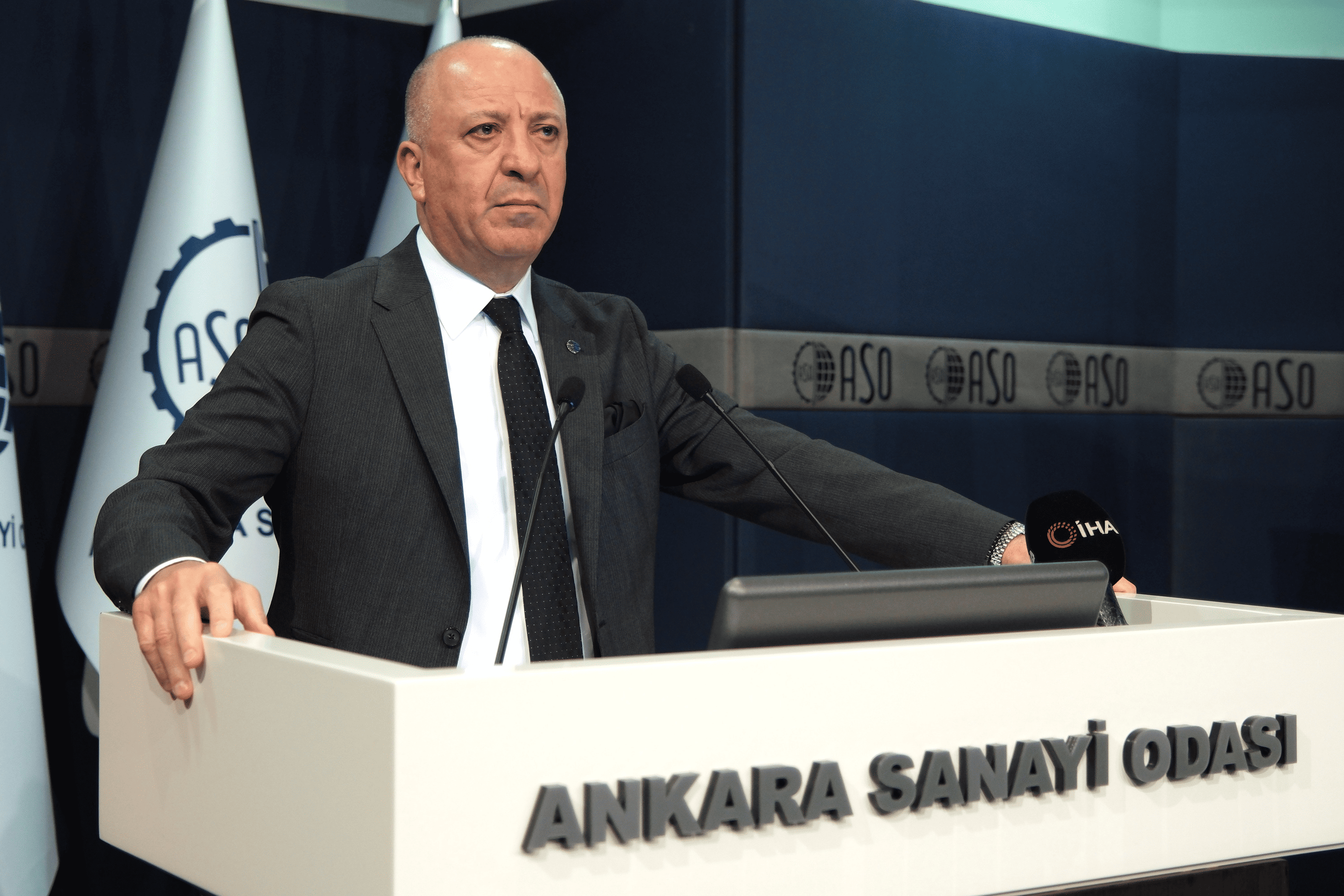
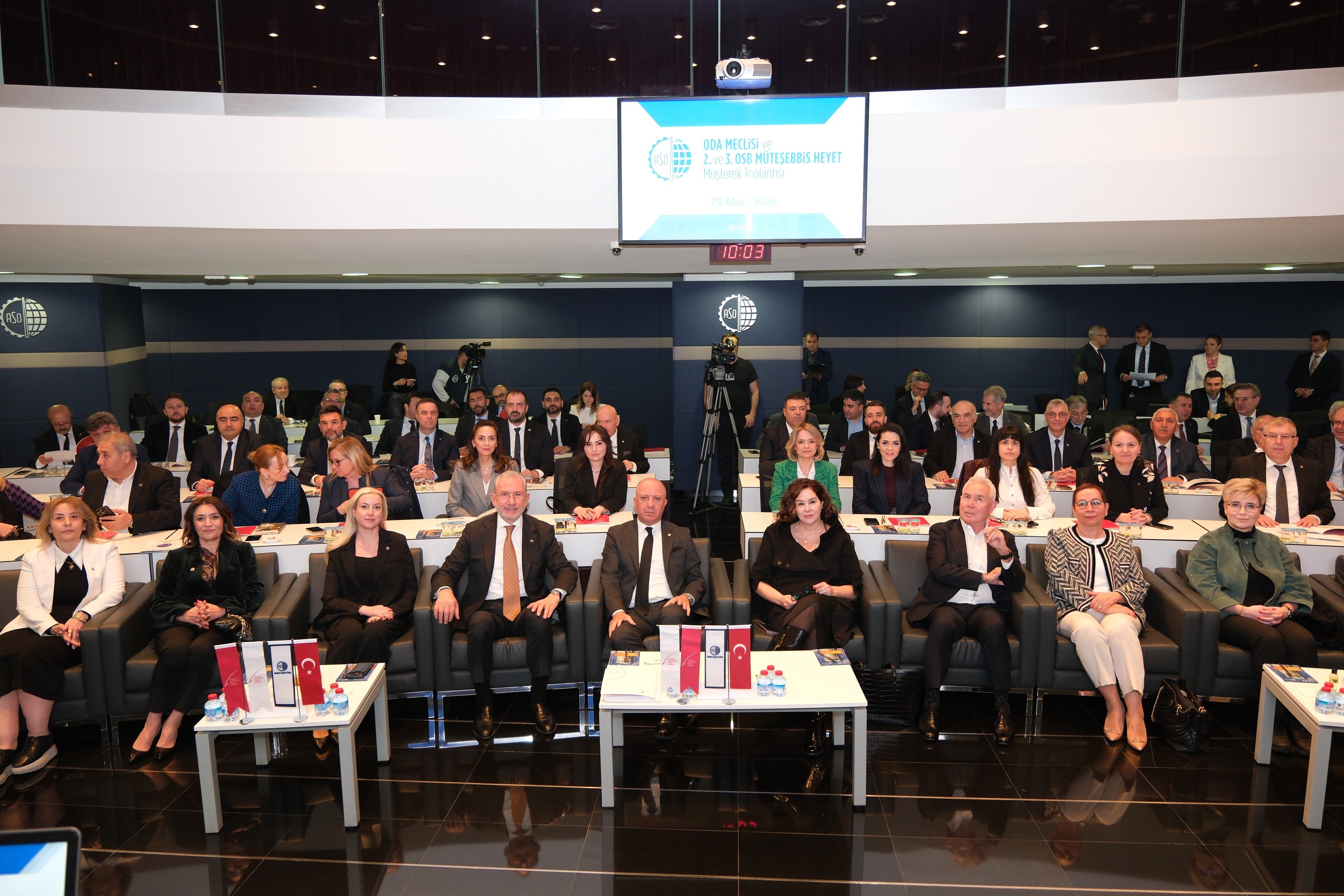
The March Assembly Meeting of the Ankara Chamber of Industry (ASO) was held under the chairmanship of ASO Assembly President Celal Koloğlu. Executives and mentors from the Women on Boards Association, Tosyalı Holding Chairman Fuat Tosyalı, and Akkök Holding Board Member Ahmet Dördüncü also attended the meeting.
In his opening remarks, ASO Chairman Seyit Ardıç addressed the effects of global developments on the economy and industry, while also sharing the problems and solution proposals of industrialists.
Emphasizing that the world economy is now shaped not only by economic dynamics but also by geopolitical developments, President Ardıç stated:
“Every month, we come before you at our Assembly meetings with the hope of discussing an agenda that prioritizes production and investment and inspires optimism for our industrialists and business community. However, I regret to say that recently the global economic agenda has been determined not by production, trade, and growth, but by increasing geopolitical tensions and conflicts. Today, the fate of the world economy is no longer written solely by figures; it is shaped by conflicts and the uncertainties created by decisions often taken far from reason and diplomacy. The global economy now speaks not only the language of markets, but also that of fault lines.”
Referring to the new spiral of conflict that began with the attacks by the United States and Israel on Iran and expanded to Gulf countries, President Ardıç stated that this process threatens not only regional security, but also energy supply security, trade routes, and global economic balances:
“The rapid increase in energy prices may once again intensify global inflationary pressures. While this further complicates monetary policies for central banks, from an industrial perspective the economic consequences of wars are more expensive energy, more expensive logistics, and higher insurance costs. This means more cautious investment decisions and a more difficult foreign trade climate. War has now turned into a wave that shakes not only borderlines but also production lines.”
President Ardıç stated that these developments should be evaluated from two perspectives for Türkiye:
“As an energy-importing country, every increase in oil and natural gas prices places pressure on our current account balance, inflation, and production costs. For us industrialists, the energy bill is not merely a cost item; it is a strategic variable that directly affects our competitiveness. Especially in a period when demand in export markets is slowing and access to financing is becoming more difficult, new energy-driven shocks make production planning even more challenging.”
“ONE END OF THE FRONTLINE IS AT THE BORDER, THE OTHER IS IN PRODUCTION AND TECHNOLOGY BASES”
Stating that the second aspect is a strategic necessity, President Ardıç continued:
“Recent developments once again clearly demonstrate a fundamental reality: A strong defense industry is a necessity. The defense industry is not only the strongest guarantor of our security, but also of our economic and technological independence.
In our era, protecting the homeland is possible not only by having armed forces, but also by possessing the technology, production power, data capacity, and strategic vision that sustain those forces according to the requirements of the age. Today, strong defense begins not only at the border, but in factories. It is built in R&D centers, laboratories, shipyards, satellite systems, software infrastructures, and cyberspace. One end of what we now call the frontline is at the border, while the other is in production and technology bases.
The issue today is no longer merely having an army; it is about establishing an independent defense ecosystem capable of developing its own aircraft, UAVs, UCAVs, air defense systems, radars, electronic warfare capabilities, rockets, missiles, software, and critical components. A nation without an army cannot protect its homeland. But let us also remember this: A nation that is not independent in defense technologies has no future.”
“TÜRKİYE IS EVOLVING INTO A GLOBAL MANUFACTURING POWER IN THE DEFENSE INDUSTRY”
Referring to Türkiye’s achievements in the defense industry, Ardıç stated:
“The momentum our country has achieved in recent years through domestic and national technologies in the defense industry is the clearest indicator of our determination in this field. Today, Türkiye is no longer merely a country that meets its own defense needs; it is becoming a manufacturing power with a global voice through the technologies it develops.”
President Ardıç thanked all those who contributed to this success:
“I would like to express my gratitude to our President, Mr. Recep Tayyip Erdoğan, for his strong vision and determination; to our Minister of Industry and Technology, Mr. Mehmet Fatih Kacır, for supporting the process through industrial policies; to the President of the Presidency of Defense Industries, Mr. Haluk Görgün, for steering our defense ecosystem with a strategic perspective; and to our foundation companies and all stakeholders of our private sector, which continue to rise in the rankings of the world’s largest defense industry companies.”
Emphasizing that economies with weak production power, dependence on foreign critical technologies, and vulnerability to energy and logistics shocks are finding it increasingly difficult to remain resilient, Ardıç stated:
“For this reason, we must extend the momentum we have achieved in the defense industry into a broader industrial transformation, deepen our capabilities in critical technologies, increase domestic production capacity, and make our industry more resilient against global shocks. Because today, the path to becoming a strong nation lies not only in protecting borders, but also in strengthening the backbone of production.”
“THE PATH TO FIGHTING INFLATION LIES IN A GROWTH MODEL CENTERED ON PRODUCTION, INDUSTRY, AGRICULTURE, AND PRODUCTIVITY”
Evaluating the Turkish economy, Ardıç drew attention to the quality of growth figures:
“In 2025, the Turkish economy grew by 3.6 percent in line with expectations. However, the real issue here is not the pace of growth, but its quality. While the agricultural sector contracted by 8.8 percent, industry remained below headline growth with only 2.9 percent growth. More importantly, over the past five years, industry’s share in national income has declined from 26.1 percent to 18 percent. In other words, the share of industry has shrunk by more than 8 percentage points since 2021. This picture reveals that production capacity is not strengthening; on the contrary, weaknesses on the supply side are deepening.”
Emphasizing the importance of production-oriented growth, President Ardıç stated:
“In an economy where supply capacity cannot be sufficiently strengthened, it is impossible to ensure lasting macroeconomic stabilization or to conduct an effective and realistic fight against inflation. If agriculture weakens, industry does not grow at the desired pace, and production capacity does not expand sufficiently, permanent price stability cannot be achieved merely by suppressing demand. The path to a realistic and sustainable fight against inflation lies in a growth approach centered on production, industry, agriculture, and productivity.”
“WHEN AGRICULTURE WEAKENS, IT IS NOT ONLY THE HARVEST THAT DECLINES, BUT ALSO THE BALANCE ON THE TABLE”
Drawing attention to the decisive role of the food group in annual inflation, President Ardıç also evaluated the agricultural sector and pointed to structural problems:
“Our agricultural sector has long been facing structural problems such as high input costs, low productivity, unplanned production, and disruptions in the supply chain. In addition, the war in the Gulf region will make the supply of fertilizers and other agricultural inputs more difficult and costly. In 2025, our agricultural production volume contracted by 10.6 percent compared to the previous year, falling to its lowest level since 2018. This creates a major risk area for food inflation and price stability. When agriculture weakens, it is not only the harvest that declines; the balance on the table is also disrupted.”
President Ardıç emphasized the importance of planned agricultural production:
“I believe that the contract farming model should be expanded. This model will strengthen supply security and contribute to price stability.”
“WE ARE ONLY CONSUMING WATER, WE ARE NOT TRANSFORMING IT INTO SUFFICIENT VALUE”
Ardıç also addressed the issue of water efficiency, noting that 77 percent of annual water consumption is used in the agricultural sector and stressing the critical importance of promoting and supporting efficient water use.
Pointing out that the economic value generated per cubic meter of water in agriculture is USD 2.36 in Germany, USD 2.18 in China, and USD 2.17 in France, while remaining at only USD 0.29 in Türkiye, President Ardıç stated:
“We are only consuming water; we are not transforming it into sufficient value.”
Emphasizing that the 2026–2035 National Water Plan published in the Official Gazette represents an important step toward more efficient use of water resources, Ardıç also highlighted the importance of effectively implementing the Basin-Based Production and Support Model:
“The effective implementation of this model will ensure the proper use of resources, the cultivation of the right products in the right regions, and increased productivity in agriculture.”
President Ardıç noted that the weakening in production narrows food supply, increases cost pressures, and complicates the fight against inflation:
“It is impossible to permanently reduce inflation in an economy where the supply side weakens and agriculture structurally loses strength.”
“SUSTAINABLE GROWTH COMES NOT FROM CONSUMPTION, BUT FROM PRODUCTION”
Addressing developments in industrial production, Ardıç stated:
“The industrial production index declined both monthly and annually in January. More importantly, it fell below 100 again after 11 months. Production capacity is weakening across many key manufacturing sectors. This indicates that our industry is facing serious challenges. The approach based on reducing inflation through exchange rate pressure has not brought inflation down to the desired levels, while significantly weakening the competitiveness of our industrialists.
Without structural reforms that increase productivity and sustainable economic policies, permanent recovery is not possible. We need an approach that will revive production and investment. Because Türkiye’s sustainable growth comes not from consumption, but from production.
The Turkish economy is growing, but this growth is not generating sufficient employment. Unfortunately, this situation is even more pronounced in the industrial sector. While there was a limited increase in the number of salaried employees in January, employment losses in industry continue. The number of employees in the industrial sector declined by 3.5 percent annually. Within one year, 174,000 people exited industrial employment. This clearly shows us that the problem is not temporary, but structural.”
“WOMEN’S POWER IN THE ECONOMY MUST BE STRENGTHENED”
Evaluating the role of women in production and management, Ardıç stated:
“The stronger participation of women in production, management, and entrepreneurship is not only a social necessity, but also a fundamental requirement for sustainable development. As the Ankara Chamber of Industry, we attach great importance to implementing this understanding not merely in discourse, but in practice. Half of our Chamber’s personnel are women. More importantly, we prioritize women’s strong representation in decision-making mechanisms. The fact that five out of our seven directors are women is a concrete indicator of this approach.”
“AS LONG AS WE MAINTAIN OUR UNITY AND SOLIDARITY, WE WILL OVERCOME THESE CHALLENGES”
Concluding his remarks with an emphasis on unity and solidarity, Ardıç said:
“Unfortunately, we are surrounded by a ring of fire. But I firmly believe that as long as we maintain our unity, solidarity, and togetherness, we will overcome these challenges as well. In this geography, surviving sometimes means daring to walk against the wind. I believe that with the prudent and balanced approach of our state, our country will overcome this process with minimal damage. I wish for a world where wars come to an end and peace and tranquility prevail.”
WOMEN ON BOARDS ASSOCIATION DELIVERED A PRESENTATION
The ASO Assembly Meeting continued with presentations by Women on Boards Association Co-Chair and Forbes Founding Partner Ayşe Burçak Güven, the Association’s mentors Tosyalı Holding Chairman Fuat Tosyalı and Akkök Holding Board Member Ahmet Dördüncü, and Association Board Member Ayşe Ayşin Işıkgece regarding the contributions of women’s participation in management levels and decision-making mechanisms to corporate success and economic and social development.
Association Co-Chair and Forbes Founding Partner Ayşe Burçak Güven stated:
“We are going through a very difficult period. Not only as Türkiye, but as a region and as the world, we are facing extremely new, complex, and chaotic challenges. To overcome these challenges, we need every possible talent, knowledge, and wisdom. Therefore, we see the presence of women as a source of support for solutions and as an essential component of sustainable development, growth, and progress — not only socially, but also institutionally.”
Association Advisory Board Member, Mentor, and Akkök Holding Board Member Ahmet Dördüncü emphasized that the current era is shaped by uncertainties and that the role of boards of directors has become more critical than ever:
“If a board of directors consists of people with similar qualifications, the diversity of perspectives and transformation it can generate will remain limited. Therefore, boards should be made as diverse as possible. One of the most important sources of potential in this regard is women.”
Women on Boards Association Mentor and Tosyalı Holding Chairman Fuat Tosyalı also thanked the Ankara Chamber of Industry for hosting the program and expressed his satisfaction in participating:
“Throughout our business lives, we openly share the experiences and expectations we have gained from boards of directors. For example, we work together on issues such as how presentations should be made to boards during times of crisis.”